
How Much Do You Need to Earn and Save to Buy a Home in Toronto in 2026?
If you have ever opened a mortgage calculator, entered your income and immediately closed the tab because the answer felt disrespectful, this article is for you.
Toronto real estate reporting tends to focus on prices. The average condo costs this much. The average semi costs that much. Detached houses have apparently left the mortal realm altogether. Those numbers are useful, but they do not answer the question buyers are actually asking: What do I need to earn and save to buy one?

Because the purchase price is only the opening act. You still need a down payment, enough income to pass the mortgage stress test, cash for Toronto’s two land transfer taxes and some money left over after closing so your first month of homeownership does not include eating exclusively from the back of the freezer.
Using July 2026 average sale prices, I calculated what it takes to buy each major type of home in Toronto: a condo apartment, freehold townhouse, semi-detached house and detached house.
The results are not exactly pocket change, but they are much more useful than another headline telling you Toronto is expensive. We have established that. Let’s get into the actual numbers.
Toronto Home Affordability in 2026: The Quick Answer
According to the Toronto Regional Real Estate Board, the average City of Toronto condo apartment sold for $672,807 in July 2026. The average townhouse sold for $867,635, a semi-detached home averaged $1,122,326 and a detached house came in at $1,547,928.
Using those average prices, here is the approximate income, down payment and total cash required to buy each one:
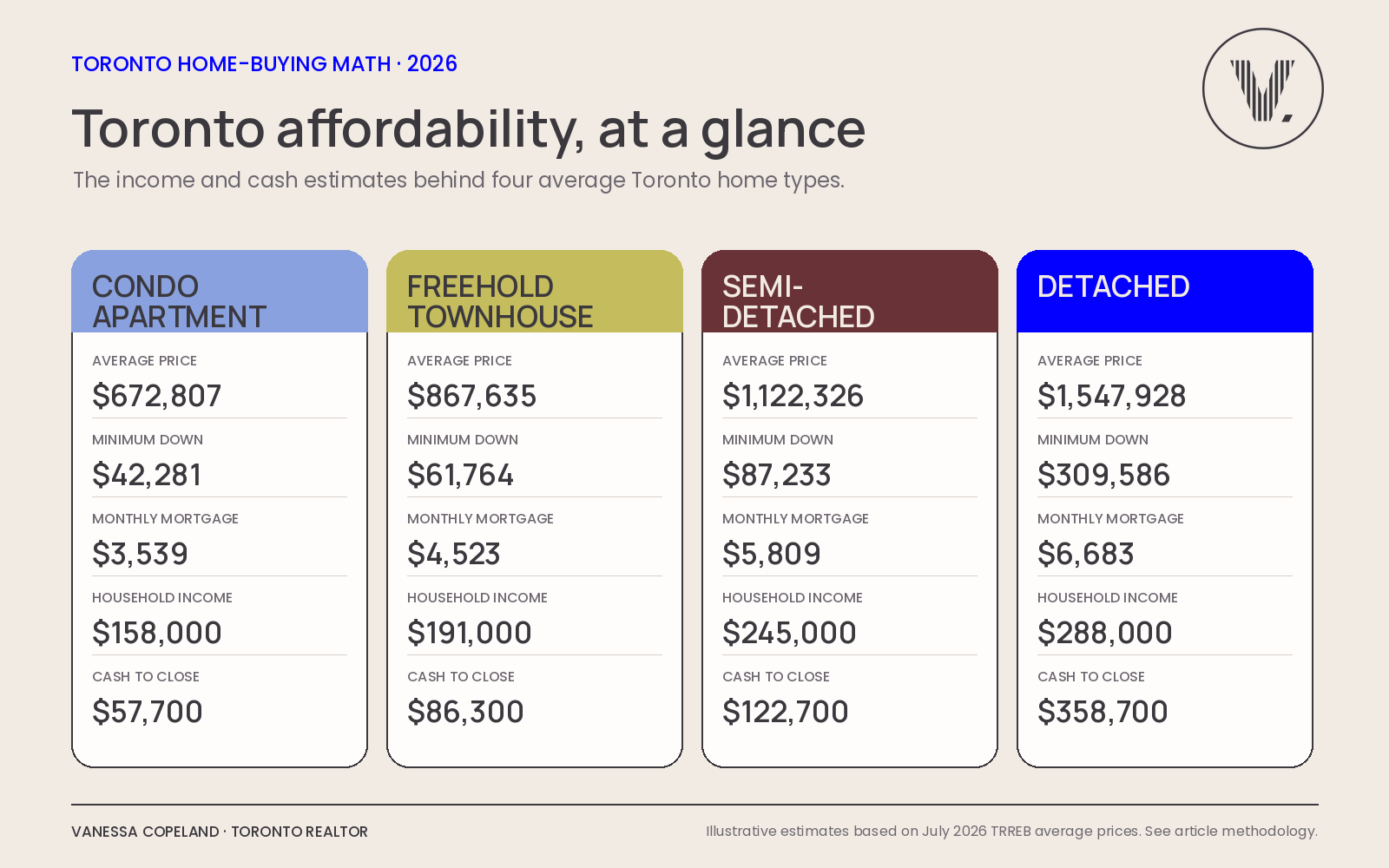
These estimates assume the buyer has no significant debt and qualifies for the maximum Ontario and Toronto first-time buyer land transfer tax rebates. If you are not a first-time buyer, add approximately $8,475 to the cash required.
The calculations also use a 4.25% mortgage rate, a 25-year amortization and mortgage qualification at 6.25%. For the condo, I included a $600 monthly maintenance fee. Property taxes and heating costs are estimated based on the property type.
In other words, these are useful planning numbers, not a pre-approval. Your lender will still want to inspect your income, credit and existing debts with the enthusiasm of someone reading the group chat after a suspicious weekend.
What Does Your Salary Actually Buy in Toronto?
Buyers do not usually begin with a property category. They begin with their income and ask what it unlocks.
Using the same assumptions, here is a rough estimate of what different household incomes could support with the minimum down payment and no major additional debt:
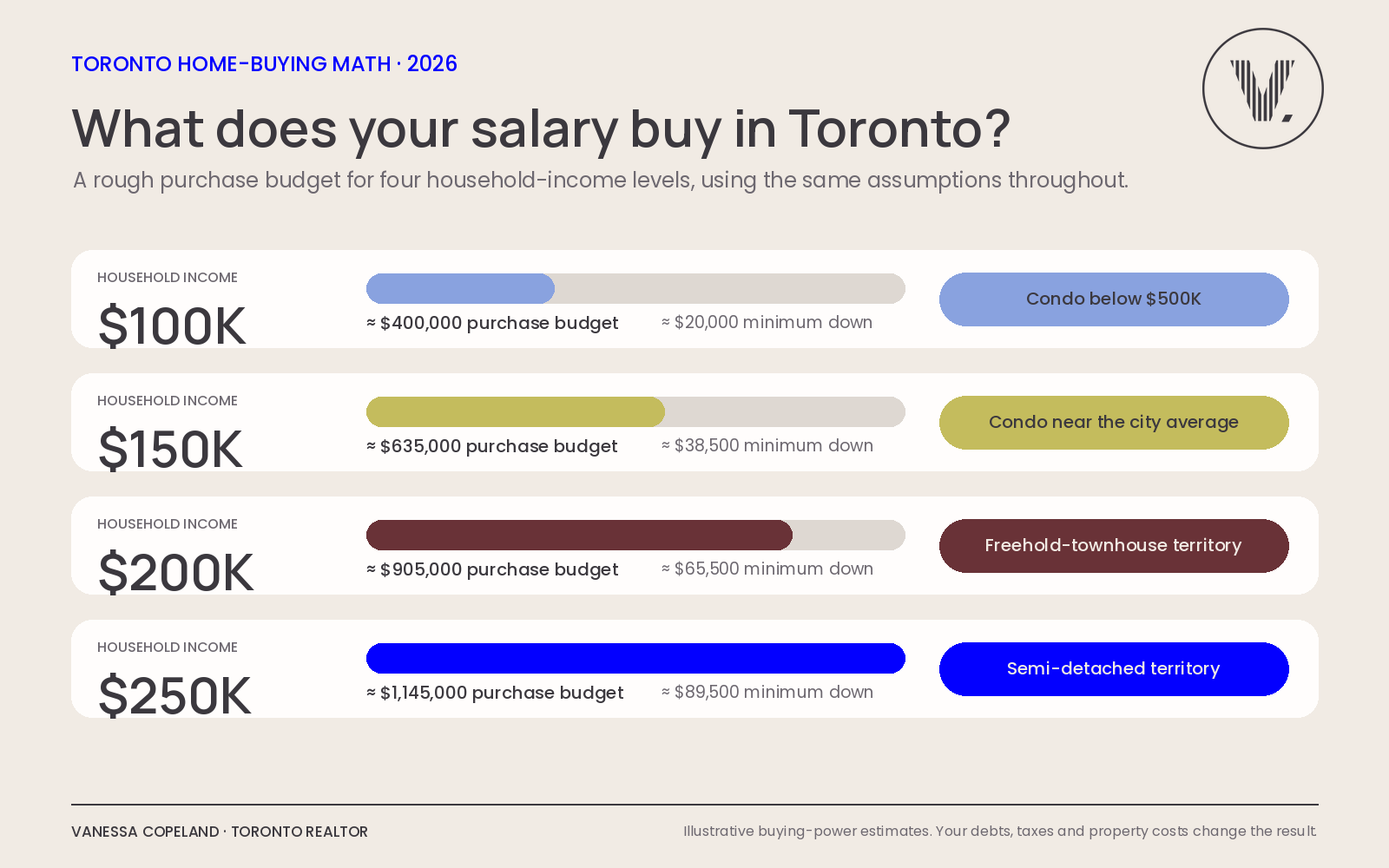
For the first two examples, I used a condo with a $600 monthly maintenance fee. For the higher incomes, I used estimated freehold costs. Different taxes, fees, heating expenses and debts will change the result.
This table also assumes you have the required savings. Qualifying for a $905,000 purchase does not help much if your down-payment fund currently contains $14,000 and a Shoppers Optimum card.
Still, it provides a useful starting point. A $100,000 household income may put you in the Toronto condo conversation. At $150,000, your options expand closer to the average condo price. Around $200,000, freehold townhouses become more realistic, while a household income near $250,000 may bring the average semi-detached home into range.
How the Calculations Work
These numbers are based on standard mortgage-qualification guidelines and several consistent planning assumptions.
CMHC generally restricts Gross Debt Service to 39% of gross household income and Total Debt Service to 44%. Condo buyers must include 50% of applicable maintenance fees in those calculations. Mortgage qualification also uses the greater of the contract interest rate plus 2% or 5.25%. You can review the formulas through CMHC’s debt-service guidance.
For this article, I used:
Toronto’s July 2026 average sale prices
An illustrative mortgage rate of 4.25%
Mortgage qualification at 6.25%
A 25-year amortization
The minimum permitted down payment
Mortgage default insurance when the down payment is below 20%
A $600 monthly maintenance fee for the condo
Estimated Toronto property taxes and heating costs
No car loans, student loans, credit card balances or other debt
Maximum first-time buyer land transfer tax rebates
Approximately $2,000 in legal costs
Approximately $750 for an inspection on freehold properties
Actual mortgage rates, approvals, insurance premiums, property taxes and closing costs will vary. This analysis was last updated in August 2026 and should be treated as a planning guide, not a lending commitment.
Basically, the calculations are detailed enough to be useful without pretending your mortgage lender will accept this blog as supporting documentation.
The Average Toronto Condo: $158,000 of Income and Nearly $58,000 Saved
Let’s start with what remains the most attainable category in the city, even if “attainable” is doing some generous work here.
The average Toronto condo sold for $672,807 in July. At that price, the minimum down payment would be approximately $42,281, calculated as 5% on the first $500,000 and 10% on the remaining amount.
Because the down payment is below 20%, mortgage default insurance would normally be required. That premium is added to the loan, bringing the approximate mortgage to $655,747. With a 4.25% rate over 25 years, the monthly mortgage payment would be around $3,539.
Unfortunately, the lender does not look at that number and say, “Sounds good to us.” You must also pass the mortgage stress test. The lender then adds property taxes, heating costs and 50% of your condo maintenance fees to the calculation.
Under those assumptions, you would need approximately $158,000 in household income to buy Toronto’s average condo with the minimum down payment and no other significant debt.
The cash required is also considerably more than the $42,281 down payment. After land transfer taxes, mortgage-insurance tax and legal fees, an eligible first-time buyer would need closer to $57,700 to close.
That is the first big lesson in this article: a down payment and a home-buying fund are not the same thing. The down payment gets all the attention, while closing costs quietly wait behind it holding an invoice.
Would Putting 20% Down Help?
Absolutely. Putting 20% down on the average Toronto condo would require approximately $134,561, but it would eliminate the mortgage-insurance premium and reduce the amount borrowed. The estimated household income requirement would fall from approximately $158,000 to about $134,000.
That can be a meaningful difference for someone with substantial savings but an income that falls short of the minimum-down-payment scenario. Of course, it also means producing another $92,000 up front, which is not the sort of money most people find in an old coat pocket.
A larger down payment can improve your approval, but I do not love the idea of buyers draining every account simply to hit 20%. The condo will still need furniture, the building may eventually increase its fees and life will continue sending bills with absolutely no regard for your beautiful new kitchen.
If you are shopping below the average, read There Are 555 Condos Under $500K in Toronto Right Now. There are opportunities in that price range, but price alone does not reveal the layout, building condition, maintenance costs or future resale pool.
The Average Toronto Freehold Townhouse: The Middle Rung Is Not Exactly in the Middle
The average Toronto townhouse sold for $867,635 in July. At that price, the minimum down payment would be approximately $61,764. After mortgage default insurance is added, the approximate mortgage would be $838,106, resulting in a monthly payment of around $4,523.
To qualify, a household would need an estimated income of approximately $191,000 per year, assuming no significant additional debt. An eligible first-time buyer would need roughly $86,300 in cash to close, or closer to $102,000 if we include a basic three-month housing cushion.
Townhouses are often treated as the tidy middle option between a condo and a detached house. You get more space, some outdoor area and fewer shared-building decisions, without having to fund the full detached-house dream. Financially, however, the jump from the average condo is not small.
Moving from the average Toronto condo to the average townhouse adds approximately $195,000 to the purchase price, nearly $1,000 to the monthly mortgage and about $33,000 to the income required.
You also trade the condo corporation’s responsibilities for your own. There may be no monthly maintenance fee, but the roof, furnace, windows and plumbing have now been assigned directly to you. Freedom feels fantastic until the furnace makes a noise that sounds expensive.
The Average Toronto Semi: Shared Wall, Serious Math
The semi-detached house may be Toronto’s most emotionally charged property type. It is the classic next step for buyers who want more space, a yard and a front door that does not open into a hallway of other front doors.
It is also now a million-dollar property that shares a wall.
The average Toronto semi sold for $1,122,326 in July. Since the purchase price remains below the $1.5 million insured-mortgage limit, a qualifying buyer could purchase it with a minimum down payment of approximately $87,233.
After mortgage default insurance, the approximate mortgage would be $1,076,497, producing a monthly payment of about $5,809 at 4.25%.
Once the mortgage stress test, property taxes and estimated heating costs are included, the household income required climbs to approximately $245,000 per year.
The bigger surprise is the amount of savings required. Although the minimum down payment is approximately $87,000, an eligible first-time buyer would need closer to $122,700 to complete the purchase.
That extra $35,000 is mainly land transfer tax, mortgage-insurance tax, legal expenses and an inspection. This is why telling someone they can buy a $1.1 million home with an $87,000 down payment is technically true and practically incomplete.
You can reach the down-payment goal and still be standing approximately $35,000 away from the front door.
The Average Toronto Semi: Shared Wall, Serious Math
The semi-detached house may be Toronto’s most emotionally charged property type. It is the classic next step for buyers who want more space, a yard and a front door that does not open into a hallway of other front doors.
It is also now a million-dollar property that shares a wall.
The average Toronto semi sold for $1,122,326 in July. Since the purchase price remains below the $1.5 million insured-mortgage limit, a qualifying buyer could purchase it with a minimum down payment of approximately $87,233.
After mortgage default insurance, the approximate mortgage would be $1,076,497, producing a monthly payment of about $5,809 at 4.25%.
Once the mortgage stress test, property taxes and estimated heating costs are included, the household income required climbs to approximately $245,000 per year.
The bigger surprise is the amount of savings required. Although the minimum down payment is approximately $87,000, an eligible first-time buyer would need closer to $122,700 to complete the purchase.
That extra $35,000 is mainly land transfer tax, mortgage-insurance tax, legal expenses and an inspection. This is why telling someone they can buy a $1.1 million home with an $87,000 down payment is technically true and practically incomplete.
You can reach the down-payment goal and still be standing approximately $35,000 away from the front door.
What If You Put 20% Down on the Semi?
A 20% down payment on the average Toronto semi would be approximately $224,465. That larger down payment would eliminate mortgage default insurance and reduce the estimated income requirement to around $209,000.
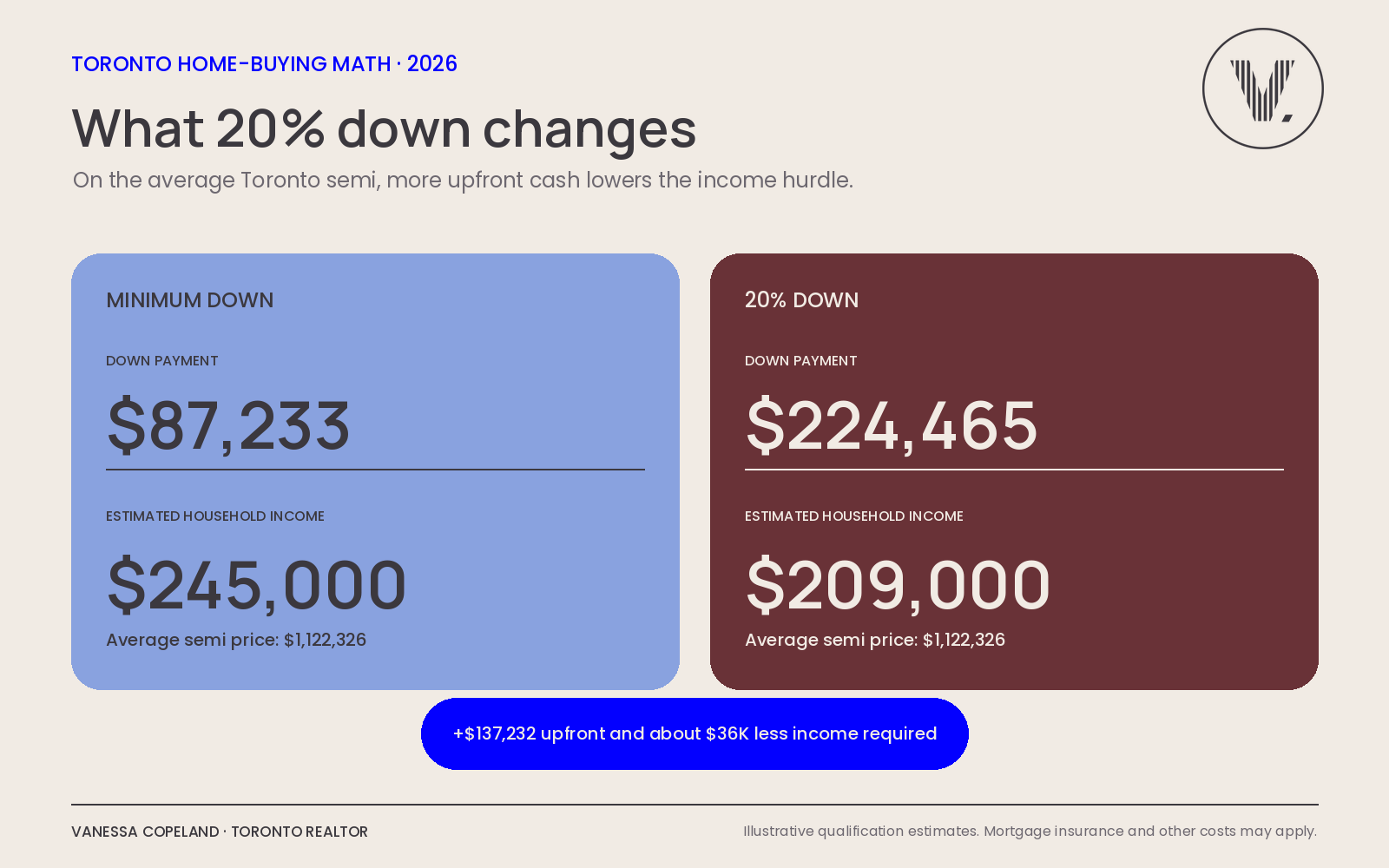
A household with strong income but less savings may be able to buy with the minimum down payment. A household with more savings but lower income may benefit from putting 20% down.
There is no universally superior option. The right strategy depends on whether your limiting factor is income, savings or how much financial flexibility you want left after closing.
The Average Toronto Detached House: The Down Payment Has Its Own Down Payment
The average detached house in Toronto sold for $1,547,928 in July 2026. Because that price exceeds the $1.5 million insured-mortgage limit, mortgage default insurance is no longer available and the minimum down payment jumps to 20%.
That means a buyer would need approximately $309,586 for the down payment alone.
After putting 20% down, the remaining mortgage would be approximately $1,238,342. At a 4.25% rate over 25 years, the monthly mortgage payment would be roughly $6,683.
With the stress test, property taxes and estimated heating costs included, the household income required would be approximately $288,000 per year. An eligible first-time buyer would need about $358,700 in total cash to close, while a repeat buyer would need closer to $367,200.
Before anyone abandons Toronto and begins searching for castles in Scotland, remember that an average is not a minimum. Luxury sales pull Toronto’s detached average upward. Smaller houses, busier streets, less expensive neighbourhoods and properties requiring work can sell well below that figure.
The average still matters because it shows how dramatically the financial equation changes once the purchase price crosses $1.5 million. The income requirement rises, but the immediate savings requirement practically leaves the building.
Buying the average detached Toronto house is not simply a high-income activity. It is also a very-high-savings activity.
What Do These Averages Actually Buy in Toronto?
Toronto-wide averages are useful for comparing property types, but they do not tell you what you will find in a specific neighbourhood.
A $672,807 condo budget can buy very different homes depending on where you look. In one downtown building, it may mean a newer one-bedroom plus den. In an older building farther from the core, it could mean more square footage, parking and an actual dining area that does not require moving your laptop first.
The same issue appears in the freehold market. An $867,635 townhouse budget will stretch differently in Scarborough, North York or the northwest end than it will near Queen West, Leslieville or the Junction. At the average semi-detached price, buyers may be choosing between location, condition, lot size, parking and how many renovation projects they are emotionally prepared to call “potential.”
A detached house below the Toronto average may involve a smaller lot, a busier street, an outer neighbourhood or substantial updating. None of those factors automatically makes it a poor purchase. The question is whether the price properly reflects the trade-off and whether that trade-off matters to you.
This is why the city-wide average is the beginning of a buying strategy, not the end. If you want more location-specific options, see my guide to the best Toronto neighbourhoods for first-time buyers in 2026.
The Amount You Need Saved Is More Than the Down Payment
The down payment is the figure everyone plans for because it is simple, visible and slightly less depressing when viewed alone.
Unfortunately, Toronto buyers must also pay both provincial and municipal land transfer tax. First-time buyers may qualify for rebates of up to $4,000 from Ontario and $4,475 from the City of Toronto, but those rebates do not erase the entire bill at today’s prices.
Buyers should also budget for legal fees, title insurance, closing adjustments and moving expenses. If the mortgage is insured, Ontario sales tax applies to the insurance premium and cannot be added to the mortgage.
Freehold buyers may also need a home inspection, sewer scope or additional specialist inspections. If you are buying an older Toronto house, I would rather discover the sewer line is collapsing before closing than learn about it through an exciting basement event six months later.
Here is how the minimum down payment compares with the estimated amount an eligible first-time buyer would actually need to close:
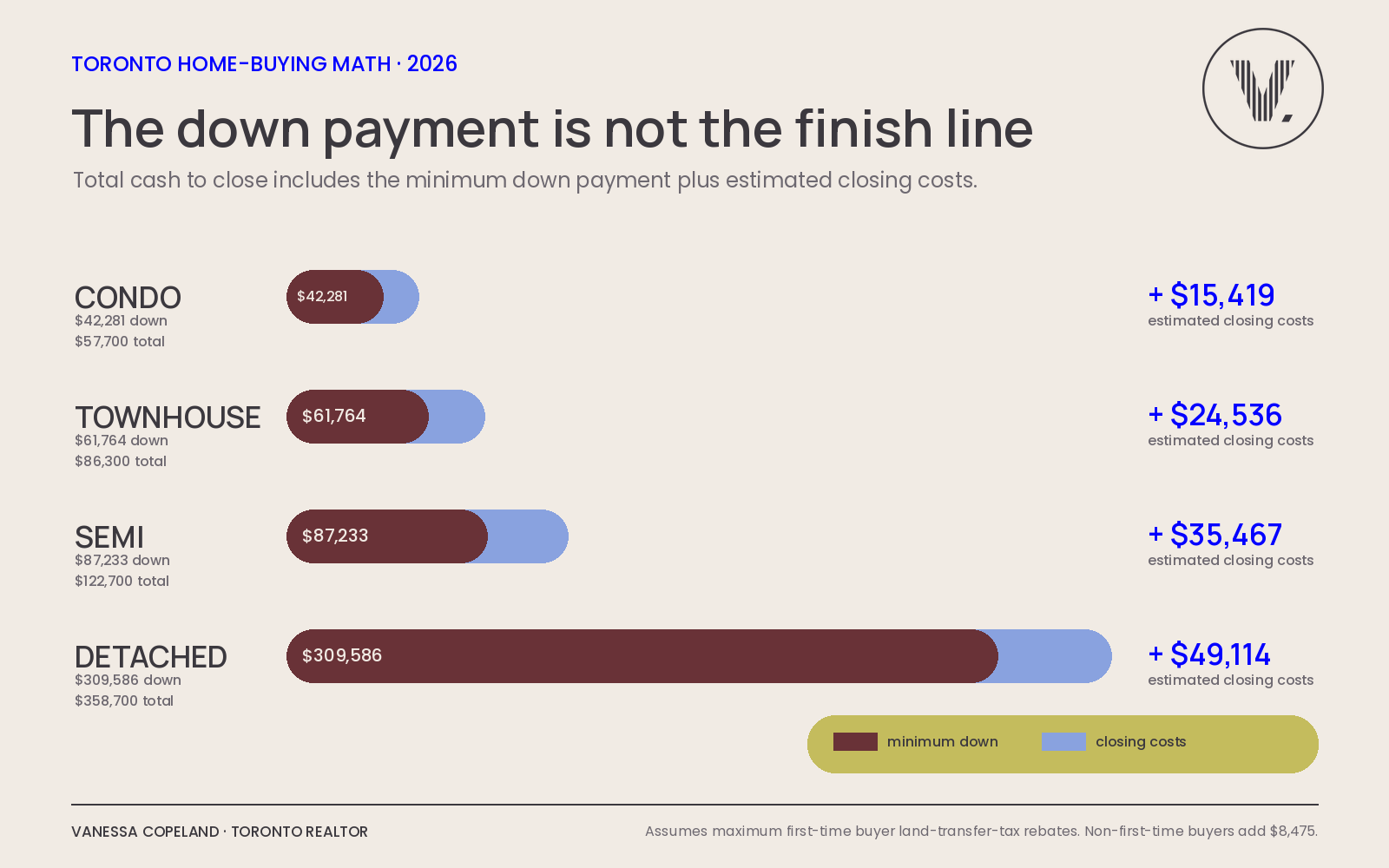
That difference deserves more attention than it usually gets. A buyer who has saved the precise minimum down payment has not finished saving. They have simply completed the most famous portion.
How Are First-Time Buyers Coming Up With the Money?
Most first-time buyers are not quietly sitting on $122,000 in a regular savings account. They are combining several sources of money, often with help from registered accounts, family or both.
The First Home Savings Account
The First Home Savings Account allows an eligible first-time buyer to contribute up to $8,000 in the year the account is opened, with a $40,000 lifetime contribution limit.
Contributions are generally tax-deductible, while a qualifying withdrawal used to purchase a first home is tax-free. It combines the tax deduction of an RRSP with the tax-free withdrawal of a TFSA, which is about as generous as Canadian tax policy gets without sending you a handwritten apology.
If two eligible buyers are purchasing together, they can each use their own FHSA. That could mean up to $80,000 in combined lifetime contributions, plus any investment growth, if both accounts have been funded over time.
The useful detail many people miss is that FHSA contribution room only begins after you open the account. If buying a home is even a medium-term possibility, opening one sooner can matter.
The Home Buyers’ Plan
The Home Buyers’ Plan currently allows an eligible buyer to withdraw up to $60,000 from an RRSP to purchase or build a qualifying home.
Two eligible buyers could potentially access up to $120,000 combined. Unlike a qualifying FHSA withdrawal, the Home Buyers’ Plan amount must eventually be repaid to the RRSP.
You can use the Home Buyers’ Plan and make a qualifying FHSA withdrawal for the same home, provided you meet the conditions for both programs.
That creates a potentially meaningful pool of registered savings, but remember that moving money out of an RRSP also removes it from long-term investment growth until it is repaid. Using every available program is not automatically the same as using them strategically.
A Gifted Down Payment
CMHC permits a traditional down payment to come from savings, the sale of another property or a non-repayable financial gift from a relative.
The lender will generally want documentation confirming where the money came from, including a signed gift letter stating that it does not need to be repaid. Parents may call it helping with the down payment. The lender prefers paperwork confirming it is not a stealth family loan with Thanksgiving enforcement terms.
Thirty-Year Amortizations
First-time buyers and purchasers of new builds may qualify for an insured mortgage with a 30-year amortization rather than 25 years.
A longer amortization reduces the monthly mortgage payment and may help some buyers qualify. It also keeps the mortgage around longer and can increase the total interest paid over time.
The calculations in this article use 25 years so every property type can be compared consistently. A mortgage broker can show you whether extending the amortization materially improves your approval and whether the long-term cost makes sense.
Land Transfer Tax Rebates
Eligible first-time buyers can receive up to $4,000 toward Ontario Land Transfer Tax and up to $4,475 toward Toronto Municipal Land Transfer Tax.
At lower purchase prices, those rebates can eliminate much of the tax. At Toronto’s current average prices, they reduce the bill but do not make it disappear.
Toronto is very committed to giving first-time buyers a rebate and then charging them two versions of the same tax.
How Much Should You Have Left After Closing?
Legally, nobody requires you to maintain a healthy emergency fund after buying. Financially, arriving at closing with exactly enough money and twelve dollars remaining is not a strategy I would recommend.
For a basic cushion, I added three months of estimated housing costs to the cash-to-close figures:
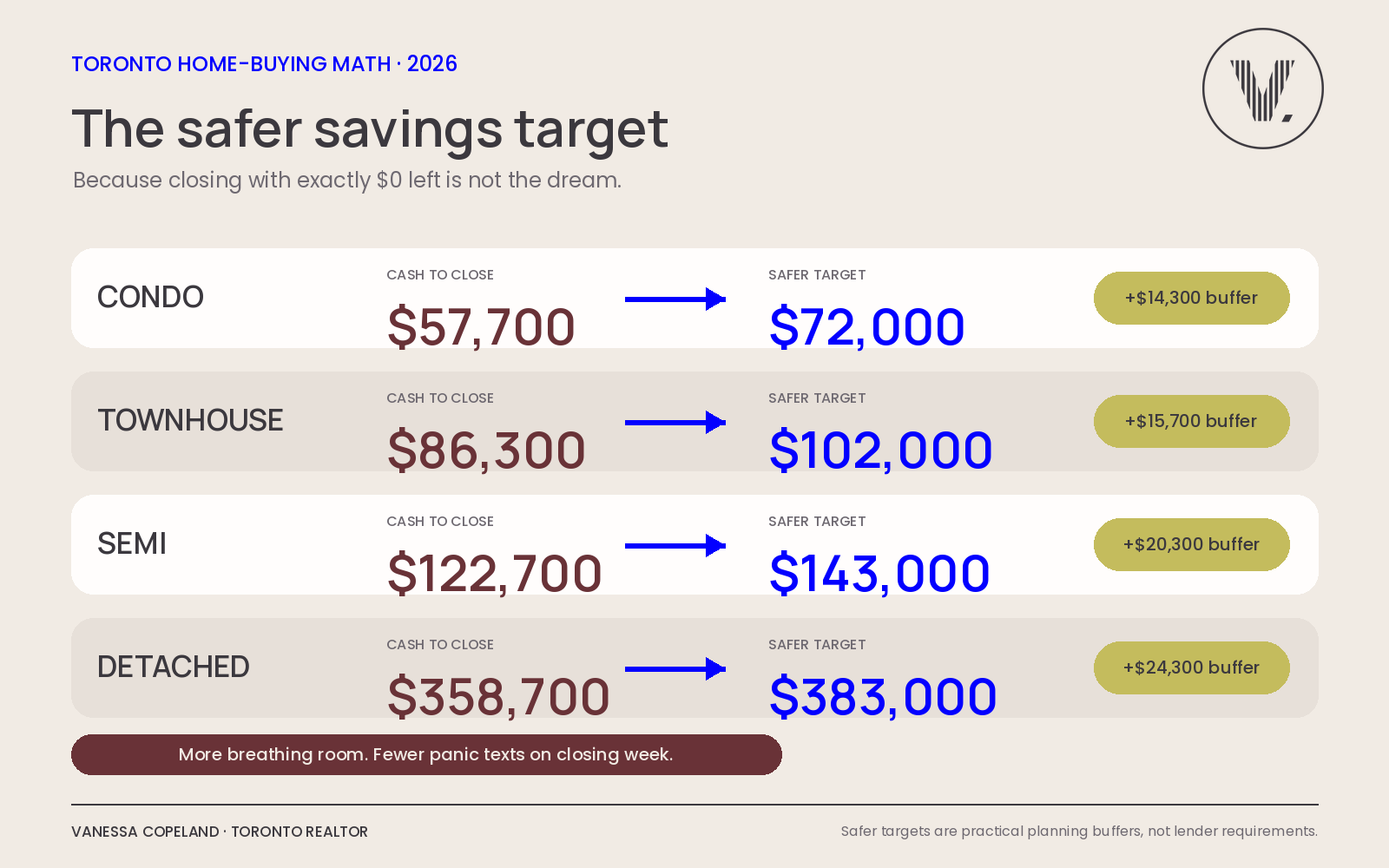
This is not an invitation to spend the cushion on dining chairs because the old ones suddenly “do not work in the space.” The money is there for closing adjustments, repairs, insurance deductibles, appliance failures and the general unpredictability of owning something with plumbing.
For an older freehold, I may recommend a larger reserve depending on the roof, windows, electrical system, furnace, sewer line, foundation and basement. A beautifully staged house can still contain decades of deferred maintenance. Throw pillows have never repaired a foundation, despite what the listing photos may suggest.
Why Your Income Is Not the Only Number That Matters
Mortgage qualification considers how much you earn, but it also cares deeply about where the rest of your money already goes.
Lenders generally use two calculations. Gross Debt Service measures your housing costs against your gross income. Total Debt Service adds payments for car loans, student debt, credit cards, lines of credit and other obligations.
That means two households earning $200,000 can qualify for very different mortgage amounts.
One household may have no debt. The other may have two car payments, a student loan and a credit card balance that has been “temporarily” hanging around since 2022. Their incomes are identical. Their borrowing power will not be.
This is also why paying off an existing monthly payment can sometimes improve your approval more than adding the same amount of money to your down payment. A good mortgage broker can model both options before you start moving money around and accidentally choose the less useful one.
How Much Income Does a Couple Need to Buy in Toronto?
Mortgage qualification normally uses combined household income, so the estimated requirements do not need to come from one person.
Using the calculations in this article, two people earning approximately $79,000 each could potentially qualify for the average Toronto condo. Two people earning around $95,500 each may be within the average-townhouse range. The average semi could require two incomes of approximately $122,500, while the average detached home could require approximately $144,000 from each buyer.
These are not salary requirements written into law. They are estimates based on a specific mortgage rate, minimum down payment and no substantial debt. A larger down payment can lower the income required, while debt, higher property taxes or expensive maintenance fees can push it upward.
The bank is interested in the combined financial picture. It is not concerned with which partner has the more impressive LinkedIn title.
Can You Buy in Toronto on a $100,000 Salary?
Yes, but likely not at Toronto’s current average prices using the minimum down payment.
A buyer earning $100,000 may still be able to purchase below the city average, particularly with a larger down payment, little debt or a co-buyer. Toronto still has condos below $500,000, and some freehold homes sell below the city-wide averages because of location, size, condition or other trade-offs.
The important thing is not to confuse “below average” with “bad.” Average prices are heavily influenced by what happened to sell that month. A small house on a busier street or a well-run condo without parking may offer considerably better value than a supposedly perfect property priced at the top of its category.
Affordability is not only about buying less. It is about understanding which compromises save money without creating a worse long-term decision.
Why Condo Fees Affect How Much You Can Borrow
When qualifying a condo buyer, lenders generally include 50% of the monthly maintenance fee in the housing-cost calculation.
If the condo fee is $600 per month, the lender adds $300. If the fee is $1,000, it adds $500.
That means a $625,000 condo with a high maintenance fee may be harder to qualify for than a $650,000 condo in a more efficient building. The cheaper purchase price does not automatically create the lower monthly obligation.
Of course, you still pay 100% of the condo fee in real life. The lender only using half of it does not mean the other half has been sponsored by the concierge.
If you are comparing buildings, read Toronto Condo Fees in 2026: What’s Normal, What They Cover and the Red Flags Buyers Miss. A fee should never be judged without looking at the unit size, inclusions, building age, amenities and financial health of the corporation.
What Toronto’s Property Ladder Actually Looks Like
The average prices show us that Toronto’s property ladder does not rise in neat, manageable steps.
Moving from the average condo to the average townhouse adds approximately $195,000 to the purchase price. The jump from a townhouse to a semi adds another $255,000. Moving from the average semi to the average detached house adds approximately $426,000 and triggers the 20% down-payment requirement because the price exceeds $1.5 million.
The rungs get farther apart as you climb.
That does not mean every buyer needs to follow the traditional condo-to-townhouse-to-semi-to-detached progression. Some buyers stay in a condo and invest the difference. Others skip the starter condo, buy farther outside the core or purchase a freehold with a rentable basement. Plenty of people buy one home that works and never feel compelled to turn housing into a competitive sport.
The right property ladder is the one that supports your actual life, not the one that looks most impressive when described at dinner.
For more current market context, read July 2026 Toronto Real Estate: July Was Hot. Toronto’s Seller’s Market Was Not.
The Bottom Line: Your Salary Is Only Part of the Toronto Home-Buying Math
Toronto is expensive. Nobody needed five charts and a small emotional breakdown to learn that. The more useful takeaway is that income alone does not determine what you can buy. Your down payment, existing debts, property taxes, condo fees and monthly comfort level all change the answer.
A household earning $250,000 with the minimum down payment is in a very different position from one earning the same amount with 20% down. More savings can reduce the mortgage, eliminate mortgage-default insurance and lower the income required to qualify.
But qualifying is only one part of the decision. The lender’s maximum approval is not automatically your ideal budget. Buying at your absolute limit may get you the house, but it can also leave you staring suspiciously at every restaurant bill and furnace noise for the next five years.
The goal is not simply to buy a Toronto home. It is to buy the right home, with a payment you can comfortably carry and enough money left over to continue having a life after closing.
Ready to Find Out What Your Numbers Buy in Toronto?
Averages are useful, but your numbers are the ones that decide the move.
If you are thinking about buying in Toronto, tell me the type of home you want, your approximate down payment and the monthly payment that feels comfortable. I will help you turn those numbers into a realistic purchase range, account for the cash you will need beyond the down payment and show you what that budget is actually buying across the city.
No pressure, no jargon and no pretending the lender’s maximum approval automatically needs to become your budget.
Show Me What I Can Buy in Toronto
These calculations are illustrative estimates based on July 2026 Toronto average prices and the assumptions explained throughout this article. They are not a mortgage approval or financial advice. Actual qualification, payments and closing costs will depend on the buyer, property, lender, interest rate and legal requirements.
Frequently Asked Questions About Buying a Home in Toronto in 2026
How much income do you need to buy a condo in Toronto in 2026?
Based on the average Toronto condo price used in this article, a household may need approximately $158,000 in annual income, along with a minimum down payment of about $42,281 and roughly $57,700 in total cash to close.
This estimate assumes a 6.25% mortgage qualification rate, a 25-year amortization, a 39% gross debt-service limit and no other household debt. Condo fees, property taxes, debt payments and the lender’s calculations can all change the result.
What salary do you need to buy a $1 million home in Toronto?
Under the same assumptions, buying a $1 million Toronto home with the minimum $75,000 down payment may require approximately $220,000 in household income.
With 20% down, the required income could fall into the high $180,000s because the mortgage is smaller and mortgage-default insurance is no longer required. A larger down payment can meaningfully change the answer, even when the household income stays exactly the same.
How much down payment do you need to buy a home in Toronto?
Canada’s minimum down payment rules are based on the purchase price:
Up to $500,000: 5% of the purchase price
Between $500,000 and $1.5 million: 5% of the first $500,000, plus 10% of the remaining amount
$1.5 million or more: 20% of the purchase price
A lender may require more depending on the borrower, property and financing circumstances. Financial Consumer Agency of Canada
Does putting 20% down reduce the salary you need?
Yes. A larger down payment reduces the mortgage amount and eliminates mortgage-default insurance.
For the average Toronto semi-detached home used in this article, increasing the down payment from approximately $87,233 to $224,465 lowers the estimated household-income requirement from roughly $245,000 to $209,000. That is approximately $36,000 less annual income required, although it takes considerably more savings upfront.
How much money do you need for Toronto closing costs?
Closing costs are separate from the down payment and generally include provincial and municipal land transfer tax, legal fees, title insurance, closing adjustments and, when applicable, Ontario tax on the mortgage-default insurance premium.
In this article’s examples, estimated closing costs range from approximately $15,419 for the average condo to $49,114 for the average detached home, assuming the maximum first-time buyer land transfer tax rebates.
Do first-time homebuyers pay land transfer tax in Toronto?
Usually, yes. Eligible first-time buyers can receive up to $4,000 from Ontario and $4,475 from the City of Toronto, but those rebates may not eliminate the full bill.
Land transfer tax increases with the purchase price. On more expensive Toronto homes, first-time buyers can still owe tens of thousands of dollars after receiving both rebates.
Can you buy a home in Toronto with a $100,000 household income?
Potentially, but the options will be limited. Under this article’s assumptions, a $100,000 household income may support a purchase price of approximately $400,000 with the minimum down payment and no other debt.
The actual budget may be lower once condo fees, property taxes, heating costs, car payments, student loans or other obligations are included. This is why the online purchase price and the comfortable purchase price are often two very different numbers.
These figures are illustrative estimates, not a mortgage approval. Your actual qualification will depend on your lender, interest rate, debts, credit, property expenses and financial circumstances.
