
Toronto Homes Are Selling Below Asking. Here's How Much You Can Actually Negotiate in 2026.
Toronto is a buyer's market, but that doesn't mean every seller is ready to negotiate. Here's how to spot an opportunity, see through the pricing games and figure out what a home is actually worth.
If you've been house hunting in Toronto lately, you've probably noticed something we haven't been able to say very often over the last decade: buyers can negotiate again. Homes are sitting longer, price reductions are becoming increasingly common, conditions have returned from the dead, and sellers are having to entertain a sentence they haven't historically enjoyed hearing: Would you take less?
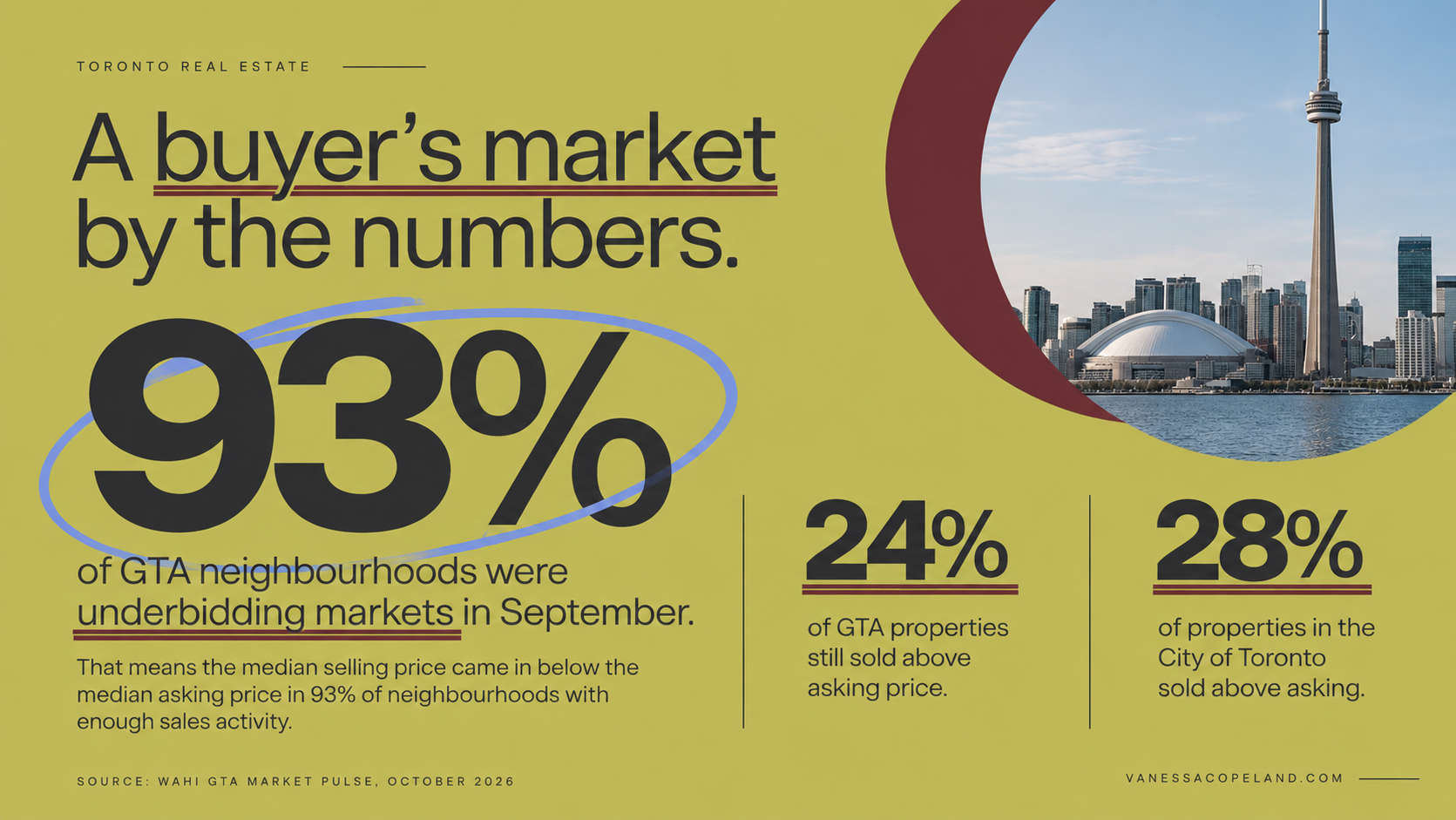
According to the Toronto Regional Real Estate Board, the average GTA home sold for $1,006,409 in September 2026, down 5.1% from a year earlier, while sales declined 9% year over year. But perhaps the more interesting number for buyers comes from Wahi's October analysis of September sales: 93% of GTA neighbourhoods with sufficient sales activity were classified as underbidding markets, meaning their median selling prices came in below their median asking prices. Toronto Regional Real Estate Board
So naturally, buyers want to know: How much below asking can I actually offer on a Toronto home right now? Unfortunately, there is no magical percentage. I cannot tell you to knock 7% off every listing and march confidently into homeownership. My job would be considerably easier if I could.
The problem is that asking price and market value are not the same thing. Sometimes they're close. Sometimes they're barely acquaintances.
Before We Talk About Going Under Asking, We Need to Talk About "Sold Over Asking"
oronto has spent years absolutely obsessed with the phrase sold over asking. You've seen the posts: SOLD $200,000 OVER ASKING! MULTIPLE OFFERS! BUYERS BATTLE FOR TORONTO HOME! Cue the champagne. Alert the media. Someone get that house a tiny trophy.
Except here's the thing. In my experience working in Toronto real estate, the vast majority of properties that sell substantially "over asking" were intentionally priced below their expected market value in the first place. It's a strategy Toronto sellers have been using for years: list low, set an offer date, attract as many buyers as possible and hope competition pushes the sale price to where you wanted it all along.
Imagine comparable sales suggest a house is worth somewhere around $1.2 million. Instead of listing at $1,199,000, the sellers list at $999,000 and hold offers for a week. Eight buyers show up, the property sells for $1.18 million, and suddenly we're celebrating a sale $181,000 over asking. Except it didn't sell for $181,000 more than it was worth. It sold for roughly what the market thought it was worth.
That's why I don't put much weight on the words over asking or under asking until I've looked at the listing strategy, listing history and comparable sales. Asking price is a marketing decision. Market value is something else entirely.
The reverse happens too. A seller can list a home for $1.3 million that the market thinks is worth $1.15 million, eventually accept $1.18 million and technically sell $120,000 under asking. Did the buyer score the deal of the century? No. The seller just started in outer space and eventually returned to Earth.
So, How Much Below Asking Can You Offer in Toronto Right Now?
Technically? As much as you want. There is no rule preventing you from offering $850,000 on a property listed for $1 million. The more useful question is whether you have any evidence suggesting the seller might actually accept it.
If a property is worth approximately $950,000 based on recent comparable sales but the seller is asking $1.05 million, I have absolutely no problem recommending an offer substantially below asking. We're not "lowballing" simply because our number happens to be lower than the number the seller chose. On the other hand, if a property is listed for $899,000 and comparable homes are selling around $1 million, walking in at $825,000 because it's a buyer's market isn't much of a negotiation strategy. It's mostly paperwork.
The goal isn't to figure out how far below asking you can go. The goal is to figure out what the property is actually worth, and then decide how aggressively you want to negotiate around that number.
The Listing History Tells Me More Than the Asking Price
One of the first things I look at when evaluating a property for a buyer isn't just the current asking price. I want the entire listing history.
Let's say you find a house listed for $999,000 and it appears to have been on the market for six days. Then we pull the history and discover it was originally listed three months ago for $1.199 million. It sat for 37 days, dropped to $1.149 million, sat again, was terminated, came back at $1.099 million and still didn't sell. Now it has magically reappeared at $999,000 with six shiny new days on market.
That's a very different property than the current listing makes it appear. Toronto sellers can terminate and relist properties, which can effectively reset the visible days on market. The house didn't develop a skincare routine. It's still been trying to sell for months.
That history tells us how buyers have already responded to the property, how many times the seller has adjusted their expectations and whether their pricing strategy is beginning to change. It can also tell us something far more useful than the current asking price: how motivated the seller might actually be.
7 Signs a Toronto Seller Might Actually Negotiate
There's no flashing sign on a listing that says SELLER IS TIRED, PLEASE MAKE OFFER. Unfortunately. But when I'm assessing how aggressively we might negotiate, these are seven things I'm looking for.
1. The Property Has Been Sitting for a Long Time
A home that's been sitting significantly longer than similar properties has already received feedback from the market, and that feedback is essentially: not at this price. Time can also change motivation as carrying costs add up and sellers get tired of keeping a house permanently ready for strangers to wander through it.
If there have been plenty of showings but no offers, that's even more interesting. Buyers are seeing the property. They're just not seeing the value.
2. It's Been Terminated and Relisted
Seven days on market doesn't mean much if the same house spent the previous three months listed at different prices. I always look at the full listing history because repeated terminations and relistings can tell us far more about the seller's experience than the shiny new listing does.
A relist doesn't automatically mean there's a deal to be had, but I want to know how long the property has really been trying to sell.
3. The Seller Has Already Reduced the Price
One price reduction tells us the original strategy didn't work. Multiple reductions tell us the seller's expectations are changing.
That doesn't automatically mean there's another $100,000 hiding under the couch, but it does give us a reason to look closely at the comparables and see whether they've finally reached market value.
4. The Property Is Vacant
Vacant doesn't automatically mean motivated, but it gets my attention. An empty property can still come with a mortgage, taxes, insurance, utilities and condo fees, and those carrying costs become considerably less charming after a few months.
The important question is why it's vacant. If the seller has already moved or purchased somewhere else, timing may matter more than it appears.
5. Comparable Homes Have Sold for Less
This is the most important one. If similar homes are consistently selling below the seller's asking price, we have actual evidence to support a lower offer.
Of course, the comparables need to actually be comparable. Renovations, parking, lot size, layout and location all matter. Finding the cheapest house sold within a kilometre and declaring victory is not a CMA.
6. Something About the Property Shrinks the Buyer Pool
A house on a busy street, beside commercial property, near train tracks, without parking or with an awkward lot simply won't appeal to as many buyers as an otherwise comparable property without those compromises.
That can create an opportunity if the issue doesn't bother you. A property's weakness doesn't have to be your weakness for you to negotiate around it. Just remember that whatever reduces the buyer pool today may do the same thing when you're eventually the seller.
7. The Seller Needs Something Other Than the Highest Price
Sometimes price isn't the seller's only priority. They may need a particular closing date, more certainty, time to move or a solution to another problem happening behind the scenes.
That's why I like finding out as much as possible before we negotiate. Sometimes giving a seller something they value can help us get movement somewhere else, including on price.
But Wait. Aren't Toronto Homes Still Selling Over Asking?
They are, and this is where the current market gets particularly interesting. Despite 93% of GTA neighbourhoods being classified as underbidding markets in September, Wahi found that 24% of individual GTA properties still sold above asking. In the City of Toronto, that figure was 28%. Wahi
That doesn't mean Toronto has suddenly flipped back into a seller's market. Remember what we just discussed about underpricing. A property expected to sell around $1.2 million can still be listed at $999,000, receive multiple offers and sell "over asking" even in a much softer market.
But there's another factor at play: good properties still sell. A well-maintained family home on a desirable street with parking, a functional layout and an attractive pricing strategy can absolutely attract competition in 2026. Meanwhile, another property five streets away can sit for 63 days wondering why nobody appreciates its "unique layout."
Toronto is not one giant housing market. There can be a buyer's market overall and still be intense competition for a particular property type, street or price point. That's why broad market statistics are useful context, but they're never enough to determine what I'd recommend offering on one specific house.
When Offering Below Asking Makes Sense
I become much more comfortable with an aggressive offer when several pieces of evidence start pointing in the same direction. If the property has been sitting for months, has gone through multiple price reductions, has no competing offers and is still priced above comparable sales, we probably have room to push.
If the seller originally tried to generate a bidding war and the property is now sitting at a higher asking price without attracting a buyer, that's worth investigating. If the property is vacant and has been carrying for months, that's useful information too. And if a nearly identical home around the corner just sold for $75,000 less, that's evidence we can actually use.
That's very different from deciding you want 10% off because somebody told you Toronto is a buyer's market. A buyer's market gives you negotiating power. It doesn't suspend mathematics.
When I Wouldn't Get Cute With the Offer
There are also properties where I wouldn't recommend trying to squeeze every last dollar out of the seller. If we've looked at the comparable sales, I genuinely believe the property is priced well, it checks boxes you've struggled to find elsewhere and there are other interested buyers circling, trying to "win" another $10,000 discount can become spectacularly shortsighted.
This is particularly true in Toronto because even in a slower market, good inventory can still be scarce. There might technically be 40 homes for sale within your price range, but if only three have the location, layout, parking, condition and lot you're looking for, you don't really have 40 options. You have three. That's the market you're actually negotiating in.
I have no interest in encouraging a buyer to overpay because they're afraid of losing a property. But I also don't think losing the right home over an amount you had already decided you could comfortably afford deserves a medal for excellent negotiating. The objective isn't to defeat the seller. It's to buy the right property at a price that makes sense.
You Can Negotiate More Than the Purchase Price
Price gets most of the attention, but a good real estate negotiation involves more than the number written at the top of the Agreement of Purchase and Sale. Depending on the property and situation, we may also be negotiating the closing date, financing and inspection conditions, repairs, inclusions, access for additional inspections or time to complete proper due diligence.
For condo buyers, that means having the opportunity to properly review the status certificate. For freehold buyers, a home inspection may uncover something that deserves further investigation. And if a property is being marketed with a basement apartment or additional rental unit, I want to know considerably more than what the listing description calls it. Before we start assigning rental income to a space, I'd quite like some evidence that the space can legally be used that way. Apparently I enjoy ruining everyone's fun with documents.
Sometimes I'd rather negotiate stronger protections for my buyer than save another $5,000 while stripping away conditions that could ultimately cost considerably more. The cheapest purchase price isn't automatically the best deal.
So, Should You Lowball a Toronto Seller in 2026?
Sometimes. I am not morally opposed to a low offer. Houses do not have feelings.
But I want a reason for the number. If a seller is asking $1.2 million and the evidence tells us the property is worth closer to $1 million, then an offer substantially below asking isn't ridiculous. It may be exactly where the conversation needs to start. If the evidence tells us the property is worth $1.2 million and you offer $950,000 because you want to "see what happens," I can probably save you the suspense.
The best negotiations aren't based on arbitrary percentages. They're based on information. How long has the property really been listed? What have comparable homes sold for? Has the seller reduced the price? Have they tried and failed to sell before? Are there other offers? What's happening with this particular property type, at this particular price point, in this particular neighbourhood?
Those questions matter considerably more than whether your offer is technically 3%, 7% or 12% below asking.
The Bottom Line: Stop Obsessing Over Asking Price
Toronto buyers have more negotiating power in 2026 than they've had during many periods over the last decade. That's a good thing. Buyers have more time to investigate properties, more ability to include conditions and, in many situations, considerably more room to negotiate.
But "under asking" isn't the same thing as "good deal." If a seller asks $1.2 million for a $1-million property and you buy it for $1.1 million, congratulations, you negotiated $100,000 off and probably still overpaid. Likewise, if you pay $50,000 over asking for a property deliberately underpriced by $100,000, you haven't necessarily lost a bidding war. You may have bought it below market value.
This is why I care much less about the percentage above or below asking than I do about the evidence behind the sale price. The asking price is simply where the seller decided to start the conversation. The number that matters is what the property is actually worth. And figuring that out is where the real negotiation starts.
Thinking About Buying in Toronto? Let’s Find the Right One.
You don’t need to have the perfect property picked out before we start working together. Whether you’re just beginning your search, trying to narrow down neighbourhoods, or already refreshing listings at an unhealthy frequency, I can help you figure out what makes sense for your budget, your life and the current market.
I’m Vanessa Copeland, a Toronto REALTOR® with Royal LePage Signature Realty, and I work with buyers through the entire process, from finding properties and spotting opportunities to digging into listing histories, analyzing comparable sales, negotiating the offer and protecting your interests through closing.
The goal isn’t just to find you a home. It’s to help you find the right home, understand what it’s actually worth and buy it on terms that make sense.
Whether you’re buying your first condo, moving up to a house or simply trying to figure out where to start, let’s talk Toronto real estate.
Frequently Asked Questions About Negotiating Home Prices in Toronto in 2026
How much below asking price should I offer on a house in Toronto in 2026?
There's no standard percentage buyers should offer below asking in Toronto. Depending on the property's market value, condition, listing history and seller motivation, an offer 5% or 10% below asking could be reasonable, too aggressive or not aggressive enough. The best starting point is reviewing recent comparable sales rather than calculating an arbitrary discount from the listing price.
Is it rude to offer $100,000 below asking price in Toronto?
Not necessarily. If a property is overpriced by $150,000 compared with similar recent sales, offering $100,000 below asking may be entirely reasonable. However, if the property is already competitively priced, the same offer could be unrealistic. Real estate negotiations should be based on market evidence, not whether the seller might find your offer offensive.
Why do Toronto homes sell over asking price?
Many Toronto properties that sell significantly above asking were deliberately listed below their expected market value to attract multiple offers. This strategy creates competition and can produce impressive-looking sale-to-list price differences. However, selling above asking doesn't necessarily mean a buyer paid above market value. The final selling price should always be evaluated against comparable properties.
Can you negotiate the price of a condo in Toronto?
Absolutely. Condo prices are negotiable, particularly when a unit has been sitting on the market, has undergone price reductions or is competing with similar listings in the same building. However, buyers should also consider maintenance fees, the building's financial health, the status certificate, upcoming repairs and recent comparable sales before deciding what to offer.
Are Toronto sellers accepting lowball offers in 2026?
Some are, but it depends on the property and the seller's circumstances. Longer listing periods, repeated price reductions, vacant properties and weaker comparable sales can create opportunities for buyers to negotiate more aggressively. However, desirable homes that are priced competitively can still attract multiple offers, even in a buyer's market.
